
If you’re searching for answers like:
- “Why is my yard dug up?”
- “What animal is digging tunnels in my yard?”
- “Why are there small dirt mounds in my yard?”
- “Why is grass dying in a line across my yard?”
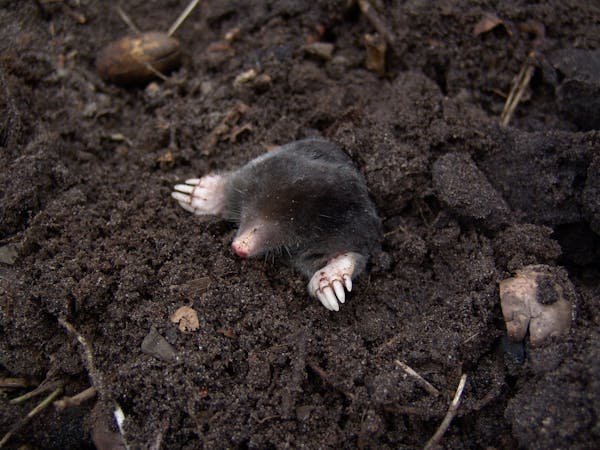
The most common cause in Missouri is the Eastern Mole.
These underground mammals can create extensive tunnel systems that damage lawns quickly and often without being seen.
What Eastern Moles Are Doing Underground
Eastern moles are not eating your grass or roots. Instead, they are constantly hunting for:
- Earthworms
- Grubs
- Beetle larvae
- Soil insects
As they move through soil, they create tunnel systems that collapse at the surface, resulting in visible lawn damage.
Eastern Mole Breeding Season (Missouri Timing)
In Missouri, mole activity increases significantly during breeding season.
Breeding Period:
- Late February through April (peak activity)
During this time:
- Males travel more frequently through tunnel systems
- New tunnels appear rapidly
- Lawn damage often increases suddenly
This is when many homeowners first notice serious mole activity.
Birth Timing and Reproduction
Typical Birth Window:
- Late March through early May
Gestation:
- About 4–6 weeks
Average Litter Size:
- 2–5 pups (commonly 3–4)
Newborn moles are:
- Blind
- Hairless
- Fully dependent in underground nests
Nesting Behavior
Moles build hidden nests deep underground in stable soil environments.
Typical nest locations include:
- Beneath tree roots
- Under structures or hardscape edges
- In undisturbed soil zones
The female constructs a central nesting chamber connected to multiple feeding tunnels used for hunting and travel.
When Young Moles Leave the Nest
Young moles develop quickly:
- 2–3 weeks: begin developing fur
- 4–5 weeks: weaned from mother
- 5–6 weeks: begin leaving the nest
By late spring and early summer:
- Juveniles establish new tunnel systems
- New damage often appears in previously unaffected areas
Signs of Eastern Mole Activity in Your Yard
Raised Surface Tunnels
These are winding, raised ridges caused by active tunneling just below the soil surface. They often feel soft when stepped on.
Dirt Mounds
Small, volcano-shaped soil piles appear when moles push excess dirt to the surface. These often appear overnight.
Linear Grass Damage
Grass may turn yellow or die in straight or curved lines due to root separation from tunnels below.
Soft or Spongy Soil
Heavy tunneling can leave hollow spaces underground, causing turf to feel unstable or sink slightly.
Best Time to Control Moles
Control is most effective when:
- Fresh tunnels are present
- Soil is moist but not saturated
- Activity is high (spring and fall)
Fresh tunnel systems indicate active moles and are critical for successful trapping.
Proven Mole Trapping Methods
Repellents and sonic devices rarely solve mole problems because they do not remove the animal.
Effective control typically involves direct trapping using:
- Scissor traps
- Harpoon traps
- Choker-style traps
Success depends on:
- Locating active tunnels
- Proper trap placement
- Consistent monitoring and adjustment
Recommended Mole Traps & Equipment
For professional-grade mole control tools and accessories:
Nature & Wildlife Solutions Mole Control Tools
These tools are selected for real-world wildlife damage control situations and field-tested effectiveness.
Wildlife Control Services
Local Wildlife Prevention & Trapping (Missouri)
We provide professional services within:
15 miles of Eureka, Missouri
Services include:
- Active mole removal and trapping
- Property prevention strategies
- Yard damage control solutions
Nationwide Virtual Wildlife Consultation
For customers outside the local service area, we offer virtual consulting across the United States.
This includes:
- Photo and video analysis of damage
- Species identification
- Step-by-step control instructions
- Trap selection guidance
- Long-term prevention planning
Final Summary
If your yard shows signs like:
- Raised tunnels
- Dirt mounds
- Grass dying in lines
- Sudden soil disturbance
You are very likely dealing with the Eastern Mole.
Correct identification and early trapping are essential for preventing long-term lawn damage.
For professional help:
- Local service: Eureka, Missouri (15-mile radius)
- Virtual consultation: Nationwide available
And for trusted trapping equipment and wildlife control tools:
Nature & Wildlife Solutions